

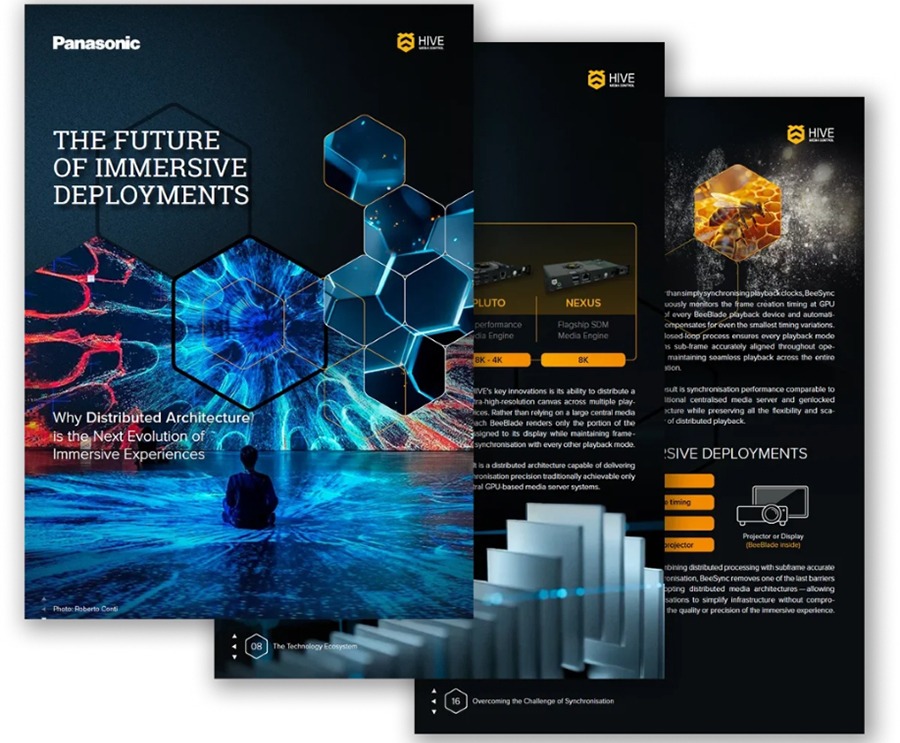
Panasonic Projector & Display Corporation and HIVE Media Control have released a new whitepaper examining how organisations can significantly reduce the infrastructure costs of immersive AV installations without compromising the visitor experience.
Entitled The Future of Immersive Deployments: Why Distributed Architecture is the Next Evolution of Immersive Experiences, the whitepaper challenges conventional approaches to immersive system design, highlighting potential savings of up to 80% in media playback and infrastructure costs when replacing legacy rack-mounted systems.
While audiences experience spectacular visuals and immersive storytelling, substantial portions of project budgets can be consumed by equipment they never see. Traditional centralised media server architectures often require dedicated equipment rooms, extensive fibre distribution, cabling, cooling and specialist installation resources.
Distributed architecture offers an alternative approach, with media playback embedded directly within compatible projectors and displays. This can dramatically reduce supporting infrastructure, simplify installation, and allow more resources to be directed towards the experience itself.
“Immersive experiences are becoming increasingly ambitious, but that shouldn’t mean the infrastructure supporting them must become increasingly complex or expensive,” commented Felix Kleisen, Sales Engineer at Panasonic Projector & Display EMEA.
“We can significantly reduce unnecessary infrastructure while maintaining the performance these environments demand. This changes the conversation for customers from how much technology is required to what they can achieve with their available budget. Ultimately, greater efficiency creates more opportunities to invest in creativity, content and audience engagement.”
Drawing on real-world deployments, including the BBC Earth Experience in Melbourne and the National Museum of Qatar, the whitepaper explores the financial implications of distributed architecture alongside its potential to improve scalability, simplify deployment, and reduce operational and environmental impacts.
Developed using the combined technological expertise and project experience of Panasonic and HIVE, the publication also examines how evolving media playback technologies are changing the economics of immersive experiences across permanent installations, touring exhibitions and visitor attractions.
“Cost and affordability have always been central to HIVE’s approach, and we’re seeing growing demand for solutions that deliver exceptional experiences without excessive infrastructure investment,” said Dave Green, CEO at HIVE Media Control.
“Importantly, HIVE remains committed to being vendor-agnostic following our acquisition by Panasonic. Our technology is not exclusive to Panasonic products, and we remain dedicated to supporting customers and partners across the wider professional AV industry, including those working with other manufacturers. The opportunities explored in this whitepaper extend well beyond any single brand, and we believe they can benefit the entire immersive AV ecosystem.”
The whitepaper is intended for AV consultants, systems integrators, rental and staging specialists, venue operators, and organisations planning immersive experiences.
To discover how distributed architecture could transform the economics of your next immersive installation, register to download the complete whitepaper here: https://eu.connect.panasonic.com/gb/en/whitepapers/future-immersive-deployments?utm_source=PR&utm_medium=email&utm_campaign=whitepaper