
How can you bring the defense capabilities of a fortress to life which has never been successfully conquered in its more than 800-year history – this challenge was at the heart of an project at Königstein Fortress in Saxony.
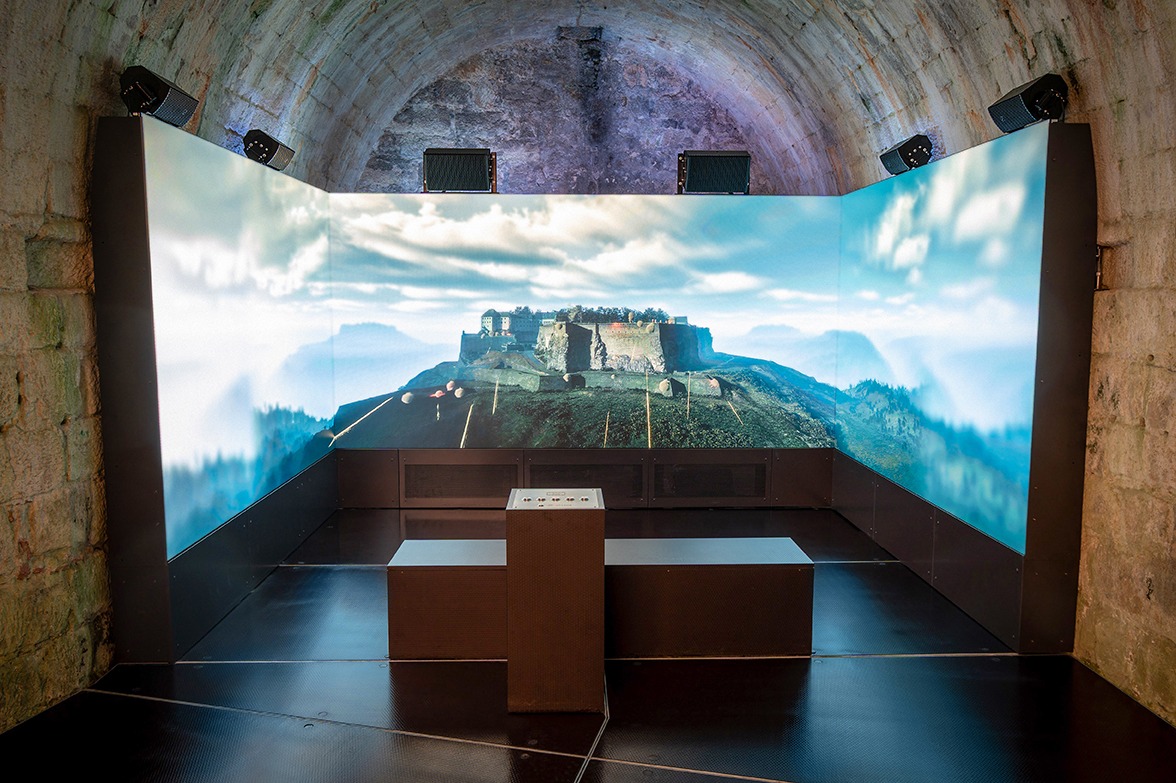
With the new interactive exhibit ‘The Storming of Königstein—An Attack That Never Happened,’ visitors can, for the first time, experience a historical attack scenario which, although it never actually happened, impressively illustrates why the fortress was regarded invulverable for centuries.
The technical implementation was carried out by Dresden-based Whitebox GmbH, and the system design was developed in collaboration with Ben Zenker (ZEN Audio Engineering) and André Neuhaus (Soundlike Großbeschallungstechnik).
Solutions from ProAudio Technology GmbH, Hoellstern GmbH, and Xcite Audio were used.
The goal was not only to convey historical content visually, but also to turn it into an immediate, immersive experience through the precise interplay of image, sound, and haptic effects.
Daniel Sommer (Whitebox GmbH) outlined: “Our ambition was not only to explain the fortress’s defense capabilities, but also to make them tangible for the visitors. The biggest challenge was to develop a technically robust solution for the particular conditions at the fortress while achieving the highest possible level of immersion. It is but the interplay of light, imagery, sound, and vibration that transforms the historical scenario into a truly impressive experience.”
On a specially designed visitor platform, historical defense scenarios are staged by large-scale visualisations, multi-channel surround sound and haptic effects. Cannons are fired, gates are closed and bridges raised while projectiles strike. The visitors don’t simply watch the events unfold – they do hear and feel them.
Ben Zenker’s engineering office was responsible for the system design of the installation. Zenker was supported in the fields of audio and system design by André Neuhaus (Soundlike Großbeschallungstechnik).
Thirty years of practical experience in applied sound reinforcement technology helped overcome the special challenges and difficulties presented by the venue.
The unique challenge was to integrate the various technical systems in such a way as to create a consistent and realistic overall experience.
Ben Zenker explained: “In immersive applications, it is not the individual component which determines the quality of the experience, but rather the interplay of all the elements involved. Our goal was to coordinate audio, haptic feedback, and visual content in such a manner that the visitors will perceive the events being depicted in an intuitive and authentic way. The result is a form of historical education that allows visitors to experience historical content on a completely new level.”
Audio technology plays a key role in the overall concept. Not only was the installation supposed to convey exceptional dynamics at a relatively low overall volume level, but also ensure maximum speech intelligibility in an acoustically daring historic setting.
A multi-channel loudspeaker system from ProAudio Technology GmbH was selected to provide sound reinforcement for the approximately 30-square-meter experience platform. The system includes four MT10 high-performance speakers, four compact MT5.2 installation speakers, and one SW12 subwoofer.
The MT10 speakers form the acoustic backbone of the installation. Their high dynamic range, precise impulse response, and excellent speech intelligibility enable a nuanced reproduction of even complex sound scenarios. These are complemented by the compact MT5.2 speakers the flat design of which allows for an unobtrusive integration into the historic architecture.
Both signal processing and amplification are provided by two 10.4-DSP ProAudio Technology system amplifiers (OEM Hoellstern). Especially with immersive applications, where the sound and vibrations from powerful shakers blend together, high-performance amplifier platforms are crucial for achieving the most realistic reproduction possible.
Rapid transient sequences, cannon salvos, and closely spaced explosions require high, load-stable power reserves as well as a precise control of complex loads.
Udo Höllstern (ProAudio Technology GmbH and Hoellstern GmbH) explained: “Immersive worlds of experience put special demands on audio technology. It’s not enough to simply play back individual effects at high volume. What’s crucial is that every scene is reproduced acoustically and physically with great tonal precision and authentic dynamics across the entire frequency range – even when some scenes contain tightly spaced and very high-impact signal sequences. Our amplifier platforms, which can handle loads as low as 2 ohms, meet such requirements perfectly.”
Due to the high power reserves, even complex sound events remain clearly separated and retain their full impression. This ensures that not only the first cannon blast, but every single action can be experienced with the same intensity and accuracy.
In addition to the acoustic dimension, the installation features a comprehensive structure-borne sound system by Xcite Audio. Eight XBS200 and four XBS100 structure-borne sound transducers were integrated directly into the visitor platform and the seating.
As a result, cannon fire, explosions or the slamming of massive gates become not only audible, but physically perceptible. The entire platform becomes an active part of the presentation.
Particularly noteworthy is the signal processing system custom developed for the haptic dimension by sound designer Felix Findeisen. Rather than simply transmitting low-frequency signals to the structure-borne sound transducers, relevant events are specifically analyzed and staged as distinct physical effects. The result is a nuanced perception which adds an extra dimension to the soundscape.
With regard to the interaction between the systems, Udo Höllstern added: “What is particularly impressive here is the interplay between sound and physical perception. Visitors do not just hear a cannon blast – they experience it. When audio, visual and haptic elements mesh so precisely, the result is a form of immersion that captivates and leaves a lasting memory.”
Another advantage of the structure-borne sound system used is the purposeful decoupling of the physical effect from the acoustic level. Since part of the energy is transmitted directly through the visitor platform, the desired intensity of many effects can be achieved without having to increase the low-frequency level in the room accordingly.
The visitors perceive cannon fire, explosions and vibrations with greater intensity, while the actual low-frequency sound exposure in the room can be reduced.
Particularly in historic buildings and sensitive exhibition environments, this approach opens up new possibilities for realising immersive experiences with a high impact while maintaining a controlled acoustic exposure. At the same time, this approach enhances the accessibility of the installation and also provides additional opportunities for people with impaired hearing to engage with historical content.
The new interactive exhibition at Königstein Fortress shows how modern media technology can be used to convey historical content. The precise interplay of scenography, media technology, audio, haptic elements, and system design is crucial to the project success.
For museums, visitor centers, and cultural institutions, this approach opens up new possibilities for conveying content in an emotional, understandable and lasting way.
The installation at Königstein Fortress illustrates that high-quality audiovisual systems today are far more than mere technical components: they become an integral part of the visitor experience and help bring history to life in new ways.
The new adventure station has thus created not only an extraordinary visitor attraction, but at the same time a remarkable example of the possibilities offered by modern immersive worlds of experience.