
When the British Museum wanted to mark the forthcoming return of the Bayeux Tapestry to England with a message of thanks to France, the White Cliffs of Dover offered an unusually appropriate canvas.
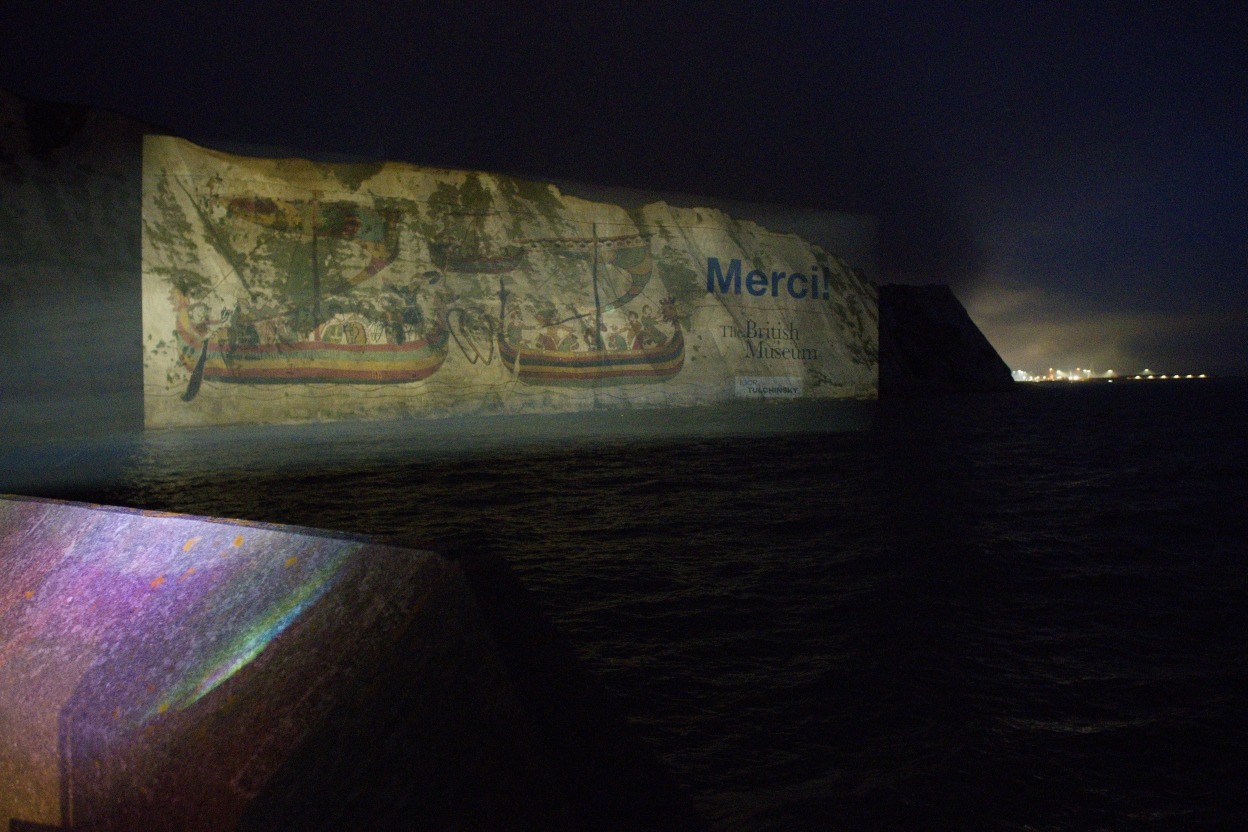
Nearly 1,000 years after the events depicted in the Tapestry, imagery inspired by the historic work appeared across the cliffs alongside a simple message: “Merci”.
For Pixel Sharp founder and director Jon Sharpe, however, turning that concept into a successful projection involved much more than pointing high-brightness projectors towards a large white surface.
The project had to be delivered at a remote location with no mains electricity, limited access and a narrow nighttime operating window. The cliffs themselves presented an irregular natural canvas, while fog and an approaching electrical storm added variables that no amount of advance planning could completely remove.
For Sharpe, that made predictability in the areas the team could control particularly important.
Pixel Sharp became involved after Anthony Pickles, Director of Communications at the British Museum, came across Sharpe’s portfolio and contacted him about the concept.
The British Museum had already developed the creative idea. Pixel Sharp’s role was to translate it into something that would work at the scale and distance required by the cliffs.
Over several meetings, Sharpe worked with the Museum’s content team to establish the usable projection area and advise on the practical limitations of treating a natural landmark as a display surface.
Unlike a conventional screen, the White Cliffs are neither flat nor consistently white. During parts of the year, areas of chalk can be covered by moss and vegetation, creating variations in colour and contrast across the surface.
That had implications for the content itself.
“Projection is light,” Sharpe says. “You have to make sure that the colours are going to give you enough punch.”
Some of the darker colours initially considered for the content therefore needed careful handling, while typography had to remain sufficiently large and clear to survive the scale, distance and texture of the projection surface.
Pixel Sharp also advised the content team to prepare alternative arrangements, including versions with imagery and text positioned differently across the available canvas.
The objective was not simply to create a design that looked good on a monitor, but one that remained legible and visually coherent once projected onto the cliffs.
The physical location added another layer of complexity. The projection position was on land rather than on a boat, but reaching it required travelling through terrain where transporting large quantities of equipment was impractical. There was also no local mains power available.
That meant the entire projection system had to be planned around what could realistically be transported to the site, installed within the available timeframe and powered from portable batteries.
For Sharpe, these considerations are fundamental to equipment selection. “When I choose technology, I’m always thinking about the logistics of installing it and how many people I’m going to need,” he says.
A projector may offer impressive performance on paper, but if deploying it requires significantly larger vehicles, lifting equipment or additional crew, the practical cost of a project can increase rapidly.
For the White Cliffs activation, equipment needed to be powerful enough to illuminate the large projection area while remaining manageable for a small production team working in a difficult-to-access location.
Four Panasonic RQ35K 4K laser projectors were deployed in two double-stacked pairs, with the overall system operating from portable battery power.
Sharpe and the wider Pixel Sharp network already had extensive experience working with Panasonic projectors on large-scale projection and immersive productions.
“We always use them. We love them,” says Sharpe. “They’re super easy to use, and we’re very accustomed to Panasonic projectors.”
He highlights several factors that become particularly valuable when equipment has to be installed quickly in challenging environments, including straightforward lens handling, familiar controls and a consistent operating approach across different generations of Panasonic products.
For large-scale mapping applications involving multiple projectors, Sharpe also favours 3-Chip DLP technology because of the importance of maintaining consistent colour and image uniformity across the complete projected canvas.
“If you’re doing a mapping job with multiple projectors, we’ll always choose 3-Chip DLP,” he says. “The colours are going to match, the adjustments are going to be better, and the uniformity throughout the image is going to be cleaner.”
That consistency can save valuable time during commissioning. On the cliffs, the Pixel Sharp team had only a limited evening window in which to position the projectors, align and map the imagery, test the system, and capture the final result.
The physical design of the projectors mattered as well. “For the power of that projector, three people can pick them up, put them on a desk and move them around,” Sharpe says. “Everything is quite straightforward.”
For Pixel Sharp, this relationship between output and portability is increasingly important as projection moves into more unusual locations.
“People always want smaller units,” says Sharpe. “It’s about more power in a smaller package.”
Once on site, the physical installation itself was comparatively familiar territory for Sharpe, who had previously worked on several projections at the White Cliffs. The projectors could be positioned within a couple of hours, with approximately another hour and a half required for mapping.
A thick bank of fog drifted across the cliffs while the team was preparing the projection. Besides reducing brightness and clarity, the fog temporarily obscured the surface that the team needed to see in order to complete the mapping. Fortunately, conditions eventually improved.
Then another problem appeared. An electrical storm was moving towards the coast.
With the Pixel Sharp team operating electrical equipment and large portable batteries in an exposed location, the approaching lightning changed the calculation quickly. The team captured the required imagery before shutting the system down earlier than originally planned.
The situation reinforced an important principle behind Sharpe’s approach to outdoor production: environmental conditions cannot always be controlled, so preparation, experience and dependable technology become critical.
“You make sure you’ve got cover, you make sure you’re protected, and you have backup plans,” he says.
The completed projection combined imagery inspired by the Bayeux Tapestry with the word “Merci”, creating a highly visible gesture of thanks to France ahead of the historic work’s return to England.
Images of the projection subsequently travelled far beyond the cliffs themselves, including being shared by French President Emmanuel Macron.
For Sharpe, the scale of the public response reflected the unusual place the Bayeux Tapestry continues to hold in the cultural imagination.
“It’s something we learn about when we’re kids,” he says. “We all learn about 1066. It’s such an incredibly important piece of history.”
The project was also significant for Pixel Sharp, a young specialist studio built around a collective of experienced technical directors, project managers, creative producers, and artists who have previously contributed to major projection and immersive projects across the industry.
Rather than maintaining a large inventory of its own equipment, Pixel Sharp draws on a network of specialist talent and technology partners according to the requirements of each production.
The White Cliffs project provided an opportunity for that expertise to appear under Pixel Sharp’s own name.
For Sharpe, projects like the Bayeux Tapestry projection also demonstrate something broader about the role of projection technology.
Audiences are surrounded by digital imagery every day, much of it encountered through familiar rectangular screens. Projection can break that pattern by placing content directly into a physical environment and allowing the location itself to become part of the message.
“The whole value is that you can take your message and give it context by placing it on a location, or by changing the shape of how it’s viewed,” Sharpe says.
That ability is particularly powerful when technology is used to interpret culture and history. Rather than replacing the object or story at the centre of an experience, Sharpe believes the most successful technology can almost disappear behind it.
“When you present something in a unique way, people are going to remember it,” he says.
It’s hard to imagine a more fitting illustration of that principle: a story nearly a thousand years old, cast in new light on the White Cliffs of Dover and shining across the Channel as a vivid reminder that, however technology changes the way we tell our stories, the future remains illuminated by the past.