

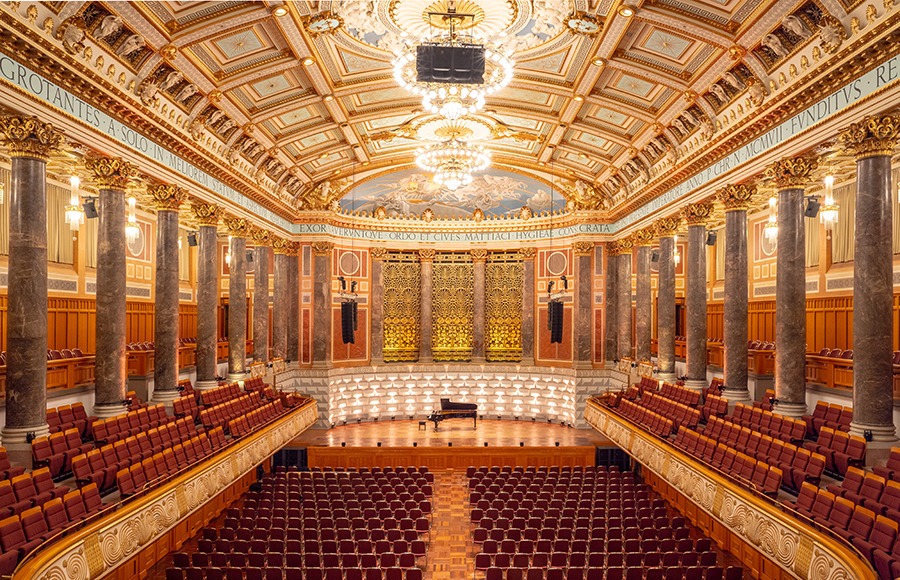
When Kaiser Wilhelm II opened the Kurhaus Wiesbaden in 1907, he called it the most beautiful spa building in the world. More than a century later, the Friedrich-von-Thiersch-Saal, the Kurhaus’s principal concert hall, still lives up to the claim. The classic shoebox room is lined with Nassau marble columns, two tiers of balconies and 1,350 seats beneath an elaborate ceiling. It hosts everything from symphonic concerts and popular music to conferences and corporate events.
An open bid
Specialist planner IFBcon first drew up a request for proposals in 2024. In it, they did not prescribe a fixed specification, instead they gave bidders free rein to develop and propose their own concepts.
AVEO bid with an L-Acoustics system and won. “Different bidders’ concepts were tested, discussed and refined throughout the dialogue phase,” says Manuel Bruckner, head of technical event management at the venue. “The final decision to go with AVEO and L-Acoustics came down to the proposed concept, competitive hearing tests, acoustic measurements and a strong commercial offer.”
Solutions both permanent and mobile
The AVEO team set about resolving a brief that called for two systems in one room: a permanent installation invisible to the eye for day-to-day use, and a full concert-grade rig brought in for major performances, all without altering a single fixing point. “For us, heritage conservation is responsibility, not restriction,” says Patrick Voccia, Commercial Director at AVEO. “This project required technical precision and a willingness to think through every task down to the last detail.”
AVEO’s day-to-day solution comprised a permanent system built into the hall’s fabric-covered recesses, and a concert system made up of a mobile rig that can be reeled in when required. The mobile system is sized to a 350kg maximum rigging load split across two 250kg pick points, a hard limit set by the roof structure. The concert stage itself compounds the challenge, since it can be extended with several risers depending on the production, so the fixed system had to be modelled to prevent crosstalk across a range of stage configurations.
“Acoustically, the Friedrich-von-Thiersch-Saal is challenging,” says Voccia. “Its shoebox proportions and expanses of polished marble were built for the natural reverberation of symphonic music, which makes controlling the diffuse-to-direct sound ratio for amplified content a balancing act. We also had to ensure the system threw minimal energy back towards the stage, even though the fixed array sits behind the performance area, to protect speech intelligibility and give performers enough gain before feedback to work with confidence.”
Working with marble
L-Acoustics Applications Engineer Martin Rode built the design in L-Acoustics Soundvision. By modelling direct sound specifically between 1kHz and 10kHz (the band where speech intelligibility and clarity live), Soundvision estimated precisely how much energy would strike the hall’s marble surfaces and route around it.
Soundvision also flagged the acoustic shadows the fixed system would otherwise leave behind, including the space behind the balcony balustrade and the corridors blocked by marble columns. It’s a large part of why the final specification pairs the main A10i hangs with 5XT and X8i in those exact positions, each addressing a shadow the software identified before installation even began. When L-Acoustics applications engineers Martin Rode and Timo Bittner measured the room during calibration, the frequency response it recorded matched the Soundvision prediction closely enough to validate the model.
A Series and Kiva II solve different needs
Behind the newly restored fabric sits the invisible half of the system: eight A10i, split into two four-box hangs either side of the stage, reinforced by two KS21i cardioid subs. The compact install cabinet and asymmetric Panflex settings of the A10i let AVEO shape narrow, controlled coverage from a housing small enough to disappear into the wall cavity, without giving up the pattern control needed to keep energy off the marble and away from the stage.
Along the side corridors, two more A10i and eight X8i take over, with the small format of the X8i allowing it to work around the marble columns that shadow that space rather than compete with them. A ring of seven 5XT near-fills, a further 12 5XT forming a delay line across the stalls, and four A10i flown horizontally at the rear of the balcony complete the fixed system, each providing even coverage across the shoebox room without feeding its natural reflections.
For live performance, AVEO brings in a full concert-grade rig: 24 Kiva II in two 12-box hangs, six SB15m across two subwoofer positions, two X8 for close-in fill and eight KS21 stacked at the stage lip for low end. Kiva II’s lightweight cabinet lets a full-range, 12-box hang stay within the venue’s 250kg pick point limit, while its output still holds up for symphonic and popular concerts alike. Eight X12 wedges complete the stage monitoring.
Both systems are driven by five LA7.16i amplified controllers.
A solution perfectly suited to the venue
The response since handover has been unambiguous. “Every mixing engineer who has worked on the new system has been enthusiastic, and event organisers who once had to bring in an external PA for larger productions say they no longer see the need,” says Voccia. “For a building where the loudspeakers themselves are barely visible, the change is entirely audible. And speech intelligibility and overall sound quality are consistently cited as the biggest improvement over the system it replaced.”
When the venue was asked what they would change about the process in hindsight, the answer was nothing. “We would carry out the project exactly the same way again,” says Bruckner. “Many of our regular clients remember the old system, and they are now thrilled by the quality of the new one. It is a PA system that is perfectly suited to the venue.”