

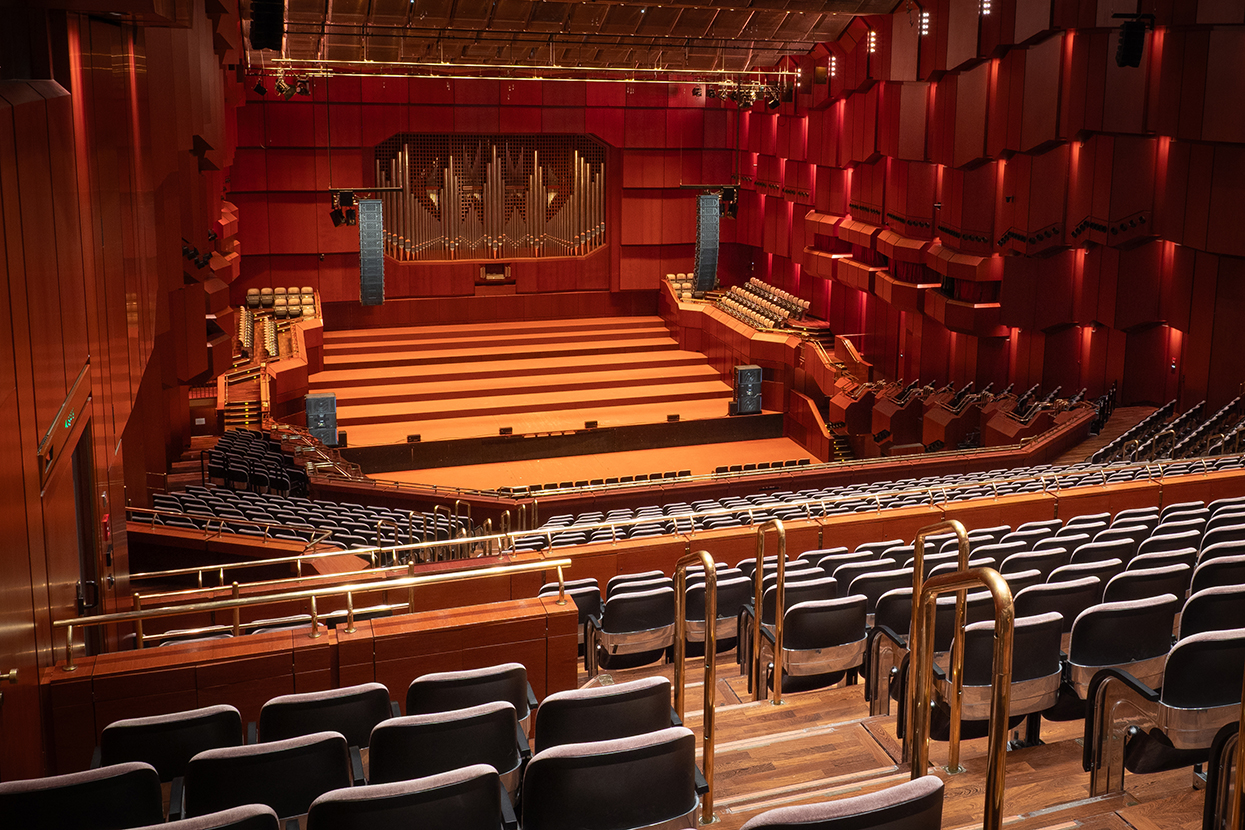
The Alte Oper Frankfurt is home to the first Meyer Sound TIGRA™ line array system in Germany. Installed in the venue’s 2,400-seat Großer Saal, or Great Hall, the system is also the first TIGRA installation in Europe to operate on an entirely digital audio signal path.
Built in 1880 as Frankfurt’s opera house and reopened as a concert hall in 1981, the Alte Oper hosts orchestral concerts, galas, conferences, and other events nearly every day. After 18 years with its previous P.A., the venue sought a self-powered, fully networked system capable of meeting the hall’s unusual physical and acoustic demands.
The Großer Saal’s main arrays are raised and lowered through a flap in the ceiling, imposing strict limits on the size and weight of the P.A. Desch Audio modified the existing rigging for the installation, but larger arrays could not fit within those limits, while smaller options lacked the required output. TIGRA met both demands.
The system comprises 18 TIGRA-L and six TIGRA-W loudspeakers in two arrays, with six 2100-LFC™ low-frequency control elements on the ground, eliminating the need to fly subwoofers. ULTRA-X40™ and ULTRA-X42™ loudspeakers cover seating flanking the stage, while ULTRA-X20™ loudspeakers provide fill. Three Galileo® GALAXY 816 Network Platforms handle upstream signal processing and routing.
A Commitment Based on Trust
Siershahn, Germany-based Desch Audio GmbH designed and installed the system. Jürgen Desch has served as the Alte Oper’s audio consultant for 35 years; about a decade ago, his company installed a self-powered Meyer Sound system in the smaller Mozart-Saal.
Desch, who has worked with Meyer Sound since 1981, committed to TIGRA based on early specifications, months before the product’s public introduction and without having heard it. “When I saw the TIGRA concept, I was sure it was absolutely the right loudspeaker,” Desch says. “I have never done this before in my life: sold a brand-new sound system that was not yet on the market.”
The hall’s previous experience with Meyer Sound helped reinforce that confidence. “We have had very positive experiences with Meyer Sound over the years,” says Alte Oper Frankfurt Head of Sound Pascal Flügel. “Their support functions flawlessly, and due to their close proximity, the supply of spare parts is very fast.”
Milan Network Simplifies Monitoring and Control
“The decision to use Milan was made even before the specific system was finalized,” Flügel says. TIGRA’s GEN-1 technology brings signal processing and networked control onboard the loudspeaker. A redundant Milan AVB network carries digital audio from the GALAXY processors through Luminex GigaCore switches to the loudspeakers, while Meyer Sound’s Nebra™ software provides centralized monitoring and control.
That visibility matters when equipment is difficult to access. With the previous system, amplifiers located above the hall powered multiple loudspeakers, making problems difficult to pinpoint. Now the house engineers can monitor individual loudspeakers and identify issues remotely. “We avoid unnecessary D/A and A/D conversions, and we are immediately alerted if a loudspeaker encounters any issues,” Flügel says.
Meyer Sound Europe supported the project with system modeling, array aiming, and on-site optimization.
The Großer Saal was rebuilt for unamplified orchestral music, with mahogany paneling on every level and seating beside the stage. The challenge is to direct sound precisely toward listeners while minimizing reflections from the surrounding surfaces.
“It’s a very difficult room,” Desch says. “When you make mistakes, you really hear them.”
“By selecting the TIGRA-W and L models, lateral reflections have been effectively minimized,” Flügel says. “The system is significantly more direct than the previous one.”
TIGRA’s controlled cardioid low-frequency pattern also reduces sound radiated toward the stage. “Due to the improved rear rejection, the stage area is now much quieter,” Flügel adds.
Once the system was installed and tuned, Desch had his first opportunity to hear TIGRA in the Großer Saal. “Calculation is one thing, and reality is another,” he says. “We didn’t expect a sound image as good as the one we have now.”