

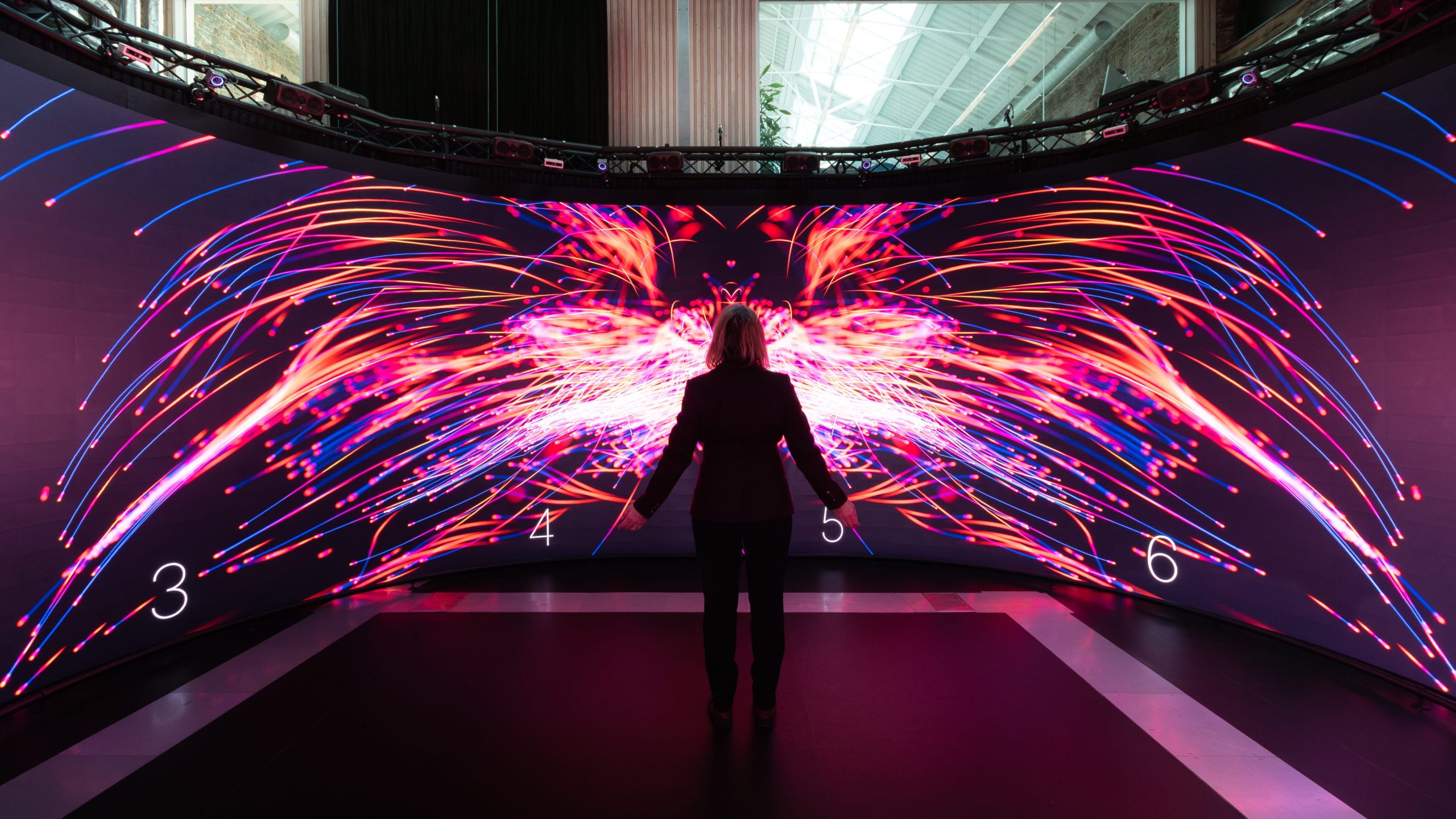
The Reality Emulator at the Bristol Digital Futures Institute (BDFI), University of Bristol, is revolutionising the way researchers explore, predict and plan for the future.
Powered by a bespoke, cutting-edge display infrastructure, the room-sized immersive environment enables users to physically step inside complex datasets, simulations, and virtual worlds in a way that traditional flat screens cannot replicate.
From first responders preparing for tomorrow’s emergencies, to researchers working towards safer cities, and architects shaping the urban landscape, the space delivers a seamless visual experience beyond conventional display capabilities.
The team at the BDFI sought to create an immersive and interactive visual emulator that would enable users to explore and visualise ideas across a wide range of research applications.
This presented a fundamental engineering challenge – traditional LED systems are typically designed around flat, independent display surfaces, but this project required a continuous, room-scale environment that would allow researchers to walk, collaborate and interact in the space without any visual interruptions.
The display also needed to balance two different use cases: curved sections to fill users’ peripheral vision and heighten immersion, alongside flat sections that could present engineering data accurately without distorting models.
The solution, therefore, required a different approach to display design. Working alongside immersive visualisation specialist Mechdyne, ClearLED engineered an integrated architectural system that made this experience possible.
The cabinet geometry, structural engineering, image processing, and immersive visuals were considered altogether from the outset, with Mechdyne defining the wider system architecture and ClearLED specifying the display technology needed to meet the project’s performance requirements.
Central to the Reality Emulator’s design is a bespoke ClearLED Ribbon Series Indoor LED platform – a 31-million-pixel curved LED wall. Overcoming the limitations of conventional large-format LED systems, the display incorporates a mosaic of 1,562 smaller modules, which bend and flex, allowing the wall to form a smooth, continuous curve that follows the precise shape of the space.
The result is an immersive display with no visible edges, flat planes or seams, all while maintaining pixel-perfect alignment and structural integrity.
The flexible 1.2-millimetre pixel pitch also made it possible to create the project’s unusual egg-shaped geometry, which could not have been achieved using standard direct-view LED panels.
“We decided ClearLED was the best supplier for this project because of the quality and reliability of the technology,” shared Richard Cashmore, Sales Chief of Staff, Mechdyne Corporation.
“The display uses flexible LED in an unusual configuration, and you simply can’t achieve that with normal direct-view LED panels. We’ve worked with ClearLED for a number of years, we trust them, and we know they deliver what they say they’re going to do.”
With the space designed for users to stand just a few feet from the LED wall, achieving both exceptional image quality and convincing depth perception was also critical to the design.
To ensure this, the LED display system features a 7680 Hz ultra-high PWM refresh rate, delivering exceptional image stability, reduced flicker and superior performance.
It also operates at 120 Hz, enabling high-definition 3D viewing through synchronised shutter glasses. When users enter the space, this configuration delivers 60 Hz independently to each eye, creating a sense of true depth in every direction.
Combined with eye tracking, motion tracking and live game-engine rendering, the system allows users to experience and respond to digital content in a more natural, spatially aware way.
Additionally, The 1.2-millimetre glue on board (GOB) flip chip design generates less heat, is more energy efficient and increases colour range and accuracy compared with general Surface-Mounted Device (SMD) LED display technology.
A glue on board protection layer was also added to the display modules, ensuring the screen was dust and water resistant, improving durability and user experience.
Rather than treating the LED hardware, display software, processing and architectural design as separate components, ClearLED and Mechdyne worked together to engineer a unified system to bring the space to life.
The system was fully assembled and factory tested in Mechdyne’s Iowa technology center before being shipped to Bristol, helping to reduce on-site installation time and ensure the different technologies worked together before delivery. Behind the scenes, a high-performance computing platform performs the complex digital-twin calculations, while a graphics cluster renders and drives the visual output on the LED display.
This approach enabled the physical display infrastructure and the advanced visual technology to function seamlessly together, spearheading the next generation of immersive digital experiences.
“The first time I heard about this project, I was very excited, as it’s a vision we have had for years,” says Gus Hadaya, President and CEO, ClearLED.
“When you’re sitting in the middle of the room, you have to be immersed in the environment; the screen has to disappear. When I walked into the finished space, it felt real. This technology allows you to be transported anywhere you want in the world and will allow scientists to go beyond what they can imagine.”
Since its completion, the Reality Emulator has become a vital component of the University of Bristol’s digital research facility.
The installation is now being used regularly for a variety of activities, including research around game-engine technology and AI, where experiences can respond dynamically rather than following a fixed, pre-programmed outcome.
“We wanted to take people into new places, new situations – potentially dangerous situations that you wouldn’t be able to put human participants into. The possibilities really are endless,” explains Dr Richard Cole, Senior Lecturer in Digital Futures, University of Bristol.
“This environment is influencing how I think and how I go onto scope projects, to imagine new ways of using technology. It’s an inspirational space to be working next to and within.”