

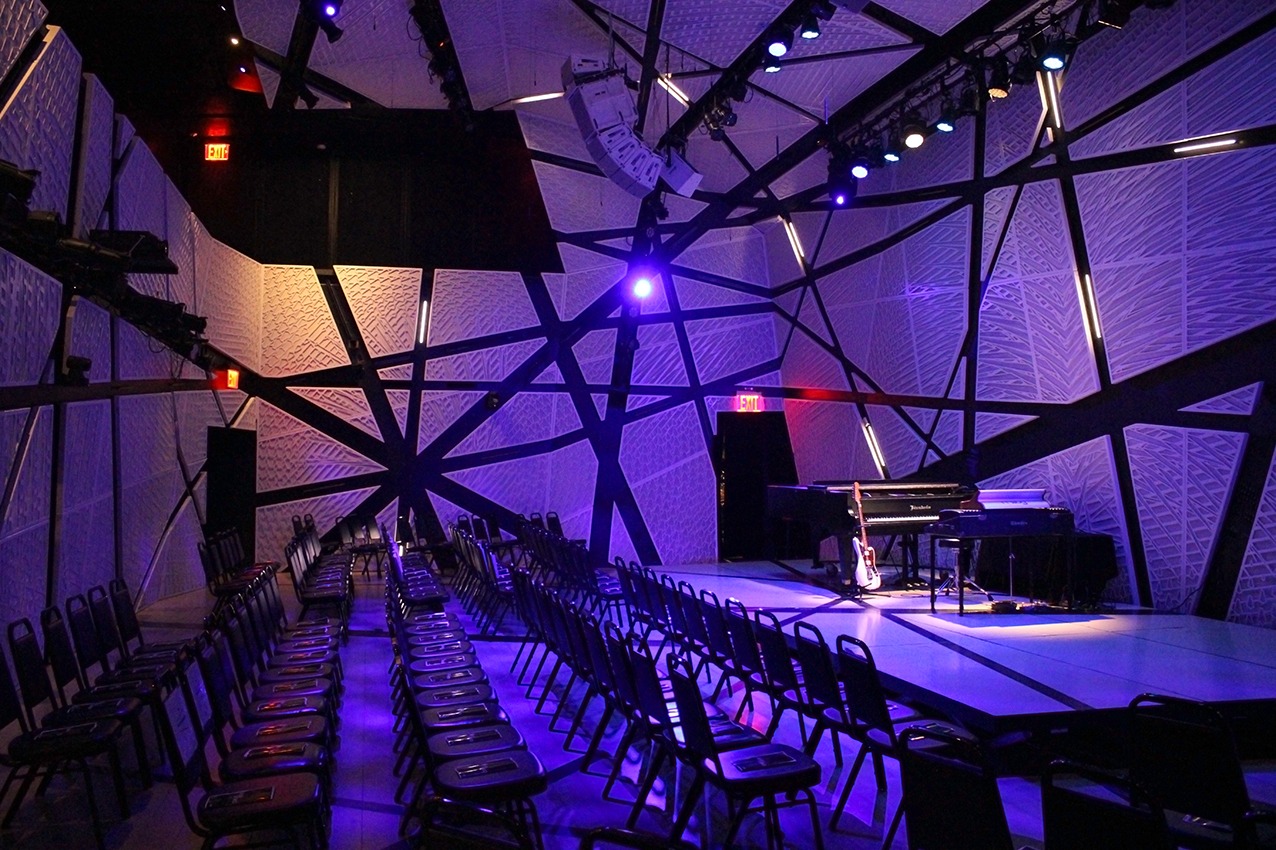
On a single night at National Sawdust, a program might feature eight composers with eight sonic setups, each asking something different of the room. One piece might send playback tracks moving around the audience; the next might call for the spacious acoustic of a cathedral; the one after that a tight, controlled room for a rock band.
This summer, the Brooklyn venue upgraded the Meyer Sound Constellation system behind those shifts, moving from D-Mitri to NADIA processing and adding a Galileo GALAXY 816 Network Platform as part of a renewed partnership.
“When we released NADIA, we said, National Sawdust is our benchmark venue for spatial audio integrated with active acoustics,” says Meyer Sound’s Director, Spatial Sound, Steve Ellison. “They need to be on our benchmark platform.”
Acoustics and Spatial Audio Share One Platform
Operating on a Milan AVB network, NADIA dedicates one processing path to Constellation active acoustics and a separate one to amplified audio. At National Sawdust, Spacemap® Go now controls spatial mixing on that second path, replacing an early version of the tool the venue had used since 2019.
Spacemap Go lowers the technical barrier to spatial audio. “What this upgrade really does is get out of the artist’s way,” says National Sawdust Executive Vice President, Business & Innovation, Ana De Archuleta. “Composers walk into this room and stop thinking about the technology. They just move sound where they want it, and reshape the room around a piece in real time.”
“Spacemap Go is something you can put in front of an artist and say, here, why don’t you try mixing it from the stage? It’s very intuitive,” says National Sawdust Director of Sound and Technical Design, Garth MacAleavey.
MacAleavey has tied both paths into his show control. “I need to create program changes in QLab to tell three different systems what to do, so that when I can’t be at rehearsal, my sound is set,” he says. “My associates can cue through the show, and the mixes will change, Constellation will change, and Spacemap Mix and Channel Snapshots will change.”
Constellation Tuning Gains Early Reflections
Constellation has shaped the room since 2019. The original installation ran a single processor devoted to reverberation; the new NADIA system provides three. “We were able to add early reflections, which enhance both the experience for musicians on stage and the audience’s spatial impression of the performance,” says Meyer Sound Senior Acoustic Engineer Jessica Borowski.
Borowski and Meyer Sound Constellation Support Specialist Leonardo Serani also rebuilt the settings the venue relied on, including an exceptionally long 10-second reverb setting.
In MacAleavey’s hands, that setting can work like an instrument, as it has with vocalist Theo Bleckmann. “We’ll do the longest reverb possible,” he explains. “He’ll arpeggiate through notes, and you’ll hear chords ringing out from his voice.”
During the upgrade, MacAleavey joined the team on the final day for an hour of focused listening, drawing on seven years of running the system. “We were able to say, ‘here’s where we’d like these starting points to be,’” he says. “Now it’s like a custom menu of exactly what our engineers and sound designers are looking for when they grab for a reverb or a tighter early reflection sound.”
Spatial Performances Translate Across Venues
NADIA and Spacemap Go make spatial work easier to move between equipped rooms. In September, musician and composer Erik Hall made his National Sawdust debut with his acclaimed interpretations of works by Steve Reich and Simeon ten Holt, playing four instruments live against recorded tracks.
The spatial sound design for his interpretation of Reich’s Music for 18 Musicians was developed with MacAleavey and Ellison during Hall’s FreshGrass Institute residency at Studio 9 in North Adams, MA. That design was then adapted for National Sawdust, and again two days later for the University at Buffalo’s Experimental Intermedia Lab.
“My solo adaptation of Music for 18 Musicians was recorded one track at a time in my home studio, and Meyer Sound’s system effectively brought my studio to the audience,” says Hall. “It turned a stereo recording into a comprehensive, three-dimensional experience, as if the listener were sitting in the room amongst the instruments. On top of that, NADIA and Spacemap Go opened up whole new avenues for creative decision-making, marking an entire new chapter for this project.”
Still, the upgrade’s biggest impact is closer to home. “This is a place where artists get to develop new works,” says MacAleavey. “Even established artists can come in and utilize this system and take their pieces and their performances completely to the next level.”
For National Sawdust, the upgrade also marks a longer commitment. “It’s the start of something bigger: a five-year partnership where Meyer Sound isn’t just outfitting our space. They’re becoming a real collaborator in the work we put on this stage,” says De Archuleta.