

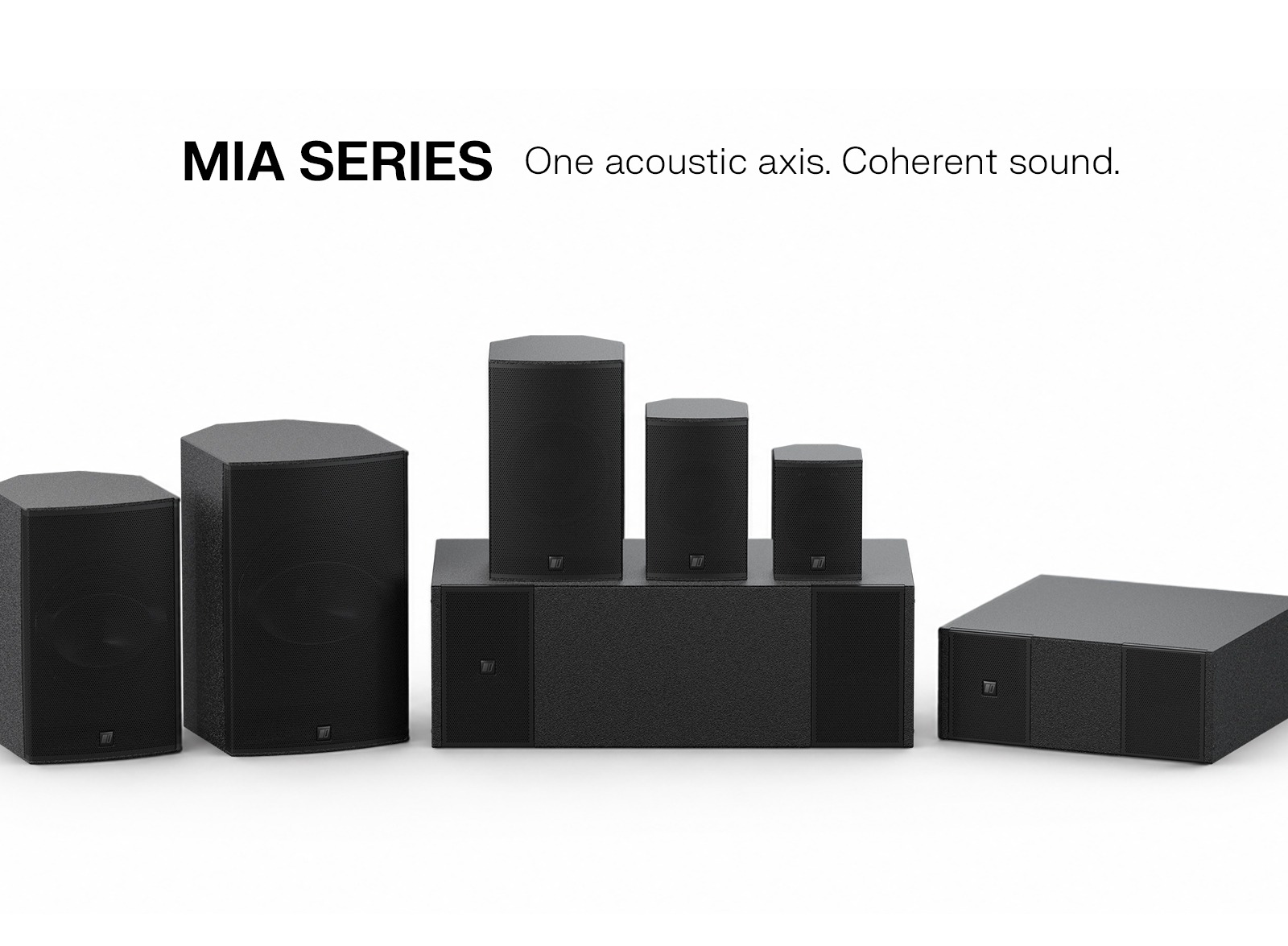
DAS AUDIO has expanded its installation portfolio with the introduction of the MIA Series, initially comprising seven coaxial point source systems and two subwoofers, together with the expansion of the INTEGRAL-MA amplified matrix range.
Together, these products combine loudspeaker systems, amplification, processing and control tools developed to operate within a single environment, simplifying the design and management of projects of different scales.
MIA is initially available as seven passive coaxial point source systems and two low-profile subwoofers.
The family includes 5-inch, 6-inch, 8-inch, 10-inch and 12-inch models with different sound pressure levels and coverage patterns, ranging from compact options for distributed installations to systems offering higher output capability and more precise dispersion control.
The MIA-X5 and MIA-X6 provide 120° conical coverage, while the MIA-X8 offers 110°. The 10” and 12” models are available with 70° × 50° and 110° × 60° coverage patterns through rotatable waveguides that have been purpose-designed and numerically optimised, allowing their orientation to be adapted to the characteristics of each space.
With a nominal impedance of 16 ohms, the MIA-X5 and MIA-X6 allow up to eight units to be connected per channel with the recommended INTEGRAL-MA matrices, optimising the use of amplification in projects requiring multiple loudspeaker locations carrying the same signal.
The MIA Series also includes the MIA-S110 and MIA-S115 subwoofers, developed to extend the low-frequency response of MIA systems in installations where space and visual integration are key considerations.
Their low-profile band-pass enclosures can be positioned horizontally or vertically, while the MIA-S110 also includes a dedicated wall-mounting accessory.
Alongside the new systems, the INTEGRAL-MA family comprises six amplified matrices with two- and four-channel configurations and power ratings ranging from 250 W to 750 W per channel at 4 ohms.
All models integrate Class D amplification, digital processing, an audio matrix and 4 × 4 Dante/AES67 connectivity, allowing routing, zones, priority levels and output processing to be managed from a single unit.
The relationship between MIA and INTEGRAL-MA goes beyond system and amplifier compatibility.
The matrices include presets with FIR filters and limiters developed specifically for each MIA model, optimising their response and maintaining phase coherence across the different systems in the series.
This makes it possible to combine different models within the same installation while maintaining a coherent response.
ALMA centralises the control, configuration and monitoring of INTEGRAL-MA matrices.
From a single interface, integrators can organise devices, manage signals and adjust the processing of the different zones within an installation.
The INTEGRAL-MA1002, MA1502, MA2004 and MA3004 incorporate a web server with ALMAweb for browser-based configuration and management.
Compatible with both low-impedance systems and 70 V and 100 V lines, they can also be integrated with external platforms through OSC and GPIO.
“With MIA and INTEGRAL-MA, we are taking an important step forward in the development of our installation portfolio. The objective was not to develop isolated products, but an architecture in which the systems, amplification, networked audio distribution, processing and control work together, providing integrators with a coherent solution from system design through to operation,” explained Germán Ramos, Director of Engineering at DAS AUDIO.
The introduction of MIA, the expansion of INTEGRAL-MA and their integration with ALMA and ALMAweb significantly broaden the scope of DAS AUDIO’s installation portfolio.
The initial MIA models and the expanded INTEGRAL-MA range establish the foundation of a family that will continue to grow to cover new formats and project requirements.