
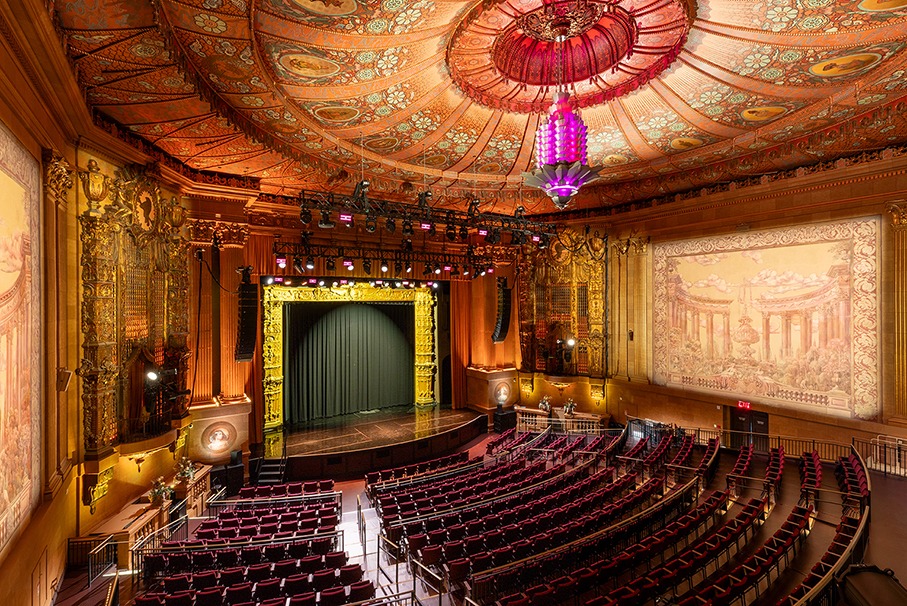
For more than a century, The Castro Theatre has stood as one of San Francisco’s most recognisable movie palaces and a cultural landmark in the city’s Castro District.
Following a two-year, $41 million renovation, the venue reopened this February with modernised facilities and new technical infrastructure designed to support live music programming – bringing a new level of capability to a room that previously operated primarily as a cinema.
As part of the upgrade, Meyer Sound provided two audio systems – an ASTRYA-based cinema presentation system and a LEOPARD system for live performances – designed to support rapid format changeovers between cinema and concert modes within in a protected historic interior.
Another Planet Entertainment, known for stewarding and programming several Bay Area venues, operates The Castro and led the renovation to support live music events alongside film presentations.
“The Castro now features a 7.1 surround system with Meyer Sound cinema loudspeakers, the world’s largest digital symphonic organ, and a state-of-the-art Meyer Sound concert P.A. system,” said Another Planet Entertainment Senior Vice President Mary Conde.
The Shalleck Collaborative served as theater and AV consultant, collaborating with CAW Architects for facility modernisation, Page & Turnbull Architects for historic preservation, and acoustics firm Salter to design and integrate interior treatment for modern production systems within a restored historic setting.
A central component of the renovation was the introduction of a custom convertible seating system.
In cinema mode, a platform system deploys to create raked seating, with upholstered chairs set in place to replicate a traditional movie theater experience.
For live events, those platforms retract into themselves and the chairs are removed entirely, transforming the room into a tiered, open-floor configuration.
The changeover, which takes approximately four hours, is supported by newly constructed backstage storage levels and a dedicated material lift designed specifically to house and transport the seating inventory.
Every design decision balanced two priorities: operational flexibility and respect for the theater’s historic architecture.
For example, “the old fixed screen had hidden the original proscenium for decades,” explained Shalleck Principal Ian Hunter.
“Now, the new roll-up screen reveals that beautifully gilded original stage, and we’re adding an LED wall where the original 1920s cinema screen would have been, to support live acts.” While Atmos presentation was considered, Hunter notes that preserving the theater’s ornate ceiling made height speakers impractical, leading designers to stick with a 7.1-channel surround system.
UltraSound provided and deployed the Meyer Sound systems. “In addition to supplying the Meyer Sound systems, we installed the performance system and commissioned both the cinema and performance systems,” explained Josh Osmond, UltraSound’s Director of Operations.
“UltraSound will also serve as audio manager for the venue—staffing and operating the system for all performances.”
The new cinema system centers around three ASTRYA-140 screen channel loudspeakers and 30 ULTRA-X20 compact point source loudspeakers as surrounds, supported by two 2100-LFC low-frequency control elements and processed by a Galileo GALAXY 408 Network Platform.
The live performance system is anchored by 12 flown LEOPARD compact linear line array loudspeakers and ten 900-LFC low-frequency control elements per side, five ULTRA‑X40 compact point source loudspeakers as fills, six ULTRA‑X20 compact point source loudspeakers as front fills, and three ULTRA‑X40 balcony delays, all processed by two Galileo GALAXY 816 Network Platforms.
“Because stage space is at a premium, the cinema speakers need to be removed and stowed for any performance other than cinema,” said Osmond.
“UltraSound designed and fabricated custom cages that ASTRYA cinema speakers mount in. The cages have pick points for rigging and wheel carts when being stowed. This allows for a smooth changeover. We can go from cinema to performance system within a 30-minute period.”
The renovation also included a major upgrade to the theater’s organ, preserving a beloved Castro tradition.
“We’re using the Meyer Sound surround speakers as part of the new organ system,” Hunter explains of the $1 million digital instrument.
“With a new lift and slip stage, the venue can feature organ performances without slowing down changeovers between cinema and live events.
“The stage opens, the lift comes up with the organ on it, and then the stage closes back over everything, all in the course of about one minute.”
Coda Technologies served as the installing AV contractor, finalising design and implementing permanent infrastructure.
To ensure the theater can adapt to future needs, Coda allowed for extensive connectivity. “We’ve got fiber, copper, and video, and ClearCom connection plates everywhere,” said Coda’s President, Mark Latimer.
“They can, depending on the need, get signal to and from wherever it’s needed.”
Installation logistics were shaped by the constraints of a historic building that limited cable routing options.
“Some cable pulls took a crew of four an entire day to do one pull,” says Latimer. For cinema accessibility, Coda integrated assistive features including Dolby closed captioning and audio narration for the visually impaired.
The real test came when the venue reopened to the public on February 6.
“When the organ rose from the stage on opening night, it was quite moving,” said Latimer.
“David Hegarty, the organist who has been at The Castro since 1978, came out in a red suit, with this huge new organ. And the whole place just erupted. It was a magical moment.”
Sam Smith’s 20-night “To Be Free: San Francisco” residency, which began February 10, served as the first high-profile test of the new system.
The theater has since anchored the 69th San Francisco Film Festival, hosting opening night screenings on April 24 and a special closing night screening of Star Wars: Episode V—The Empire Strikes Back in collaboration with Lucasfilm and Another Planet Entertainment on May 4.
Together, audio and infrastructure upgrades position The Castro for a new era of programming while preserving its architectural identity.
“Thanks to Meyer Sound’s support, the newly reopened Castro Theatre is a triumph of superior audio design and implementation,” said Conde. “Their dedication and professionalism has ensured the Castro’s legacy for another 100 years.”