

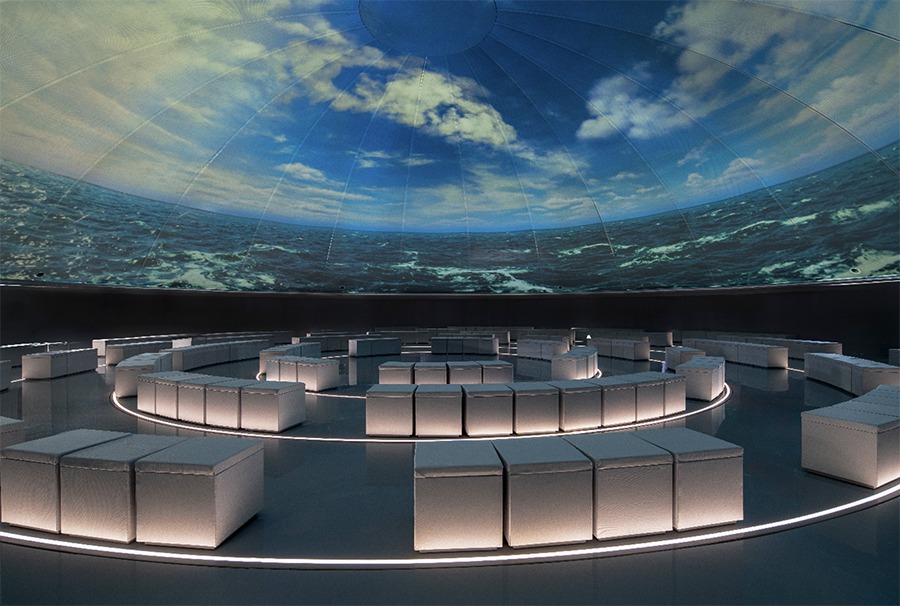
To mark Zara’s 50th anniversary, British artist and designer Es Devlin was invited to create a gift for the city where the brand was born: a 20-minute immersive experience housed in a newly reimagined dome at the top of Mount San Pedro in A Coruña, Spain.
50 Songs of the Sea, open to the public from July through October, invites guests into a custom-built environment that blends film, music, poetry, and kinetic architecture, all framed by a fully immersive sound experience designed by Auditoria.
Auditoria were brought on board by producers LarMac and Es Devlin Studio to design and deliver the spatial audio system and show control for the installation, working in close collaboration with Polyphonia (music and sound design content), VYV (video systems), WonderWorks (technical production), and others.
“It’s a beautiful piece of work,” said Scott Willsallen, CEO and founder of Auditoria. “The film celebrates the people and place of A Coruña, and it’s been built as a gift to the community. It was a privilege to help bring Es’s creative vision to life through sound.”
The project was developed for the Atlantic Dome Observatory, a once-abandoned concrete structure perched above the Atlantic Ocean, now transformed into a striking cultural venue.
Inside, 288 guests are seated across five concentric rings, some stationary, others rotating, to fully immerse them in the projected visuals and enveloping audio.
But the dome brought a particular acoustic challenge. “Domes are notoriously difficult spaces for sound,” said Willsallen.
“You get this effect where sound reflects off the curved surfaces and focuses right back at the centre, like a delayed mirror of your own voice, just as loud as the original. It’s incredibly distracting for speech and spatial sound.”
To counter this, Auditoria developed a bespoke acoustic solution. “We treated the entire interior surface with sound absorption to reduce those reflections, but that alone made the space feel too dead. So we added a doughnut-shaped acoustic reflector, hidden above the projection surface, to restore some liveliness to the room, just not in a way that reinforced the dome’s natural acoustics.”
The sound system itself was carefully integrated behind the fabric projection surface and within the complex framework of the dome. It includes 24 loudspeakers placed around the horizon, 12 mid-height speakers, and a central overhead source.
Low frequencies are delivered by 12 subwoofers, and more than 30 small speakers surround the perimeter to support guests seated at the very rear of the space.
The show was created using L-Acoustics’ L-ISA spatial audio tools, authored in Pro Tools, and rendered for playback via a dual-redundant QLab system, remotely operated through a custom-designed Q-SYS interface.
“There’s no permanent operator on site, so everything had to be effortless,” noted Willsallen. “The system is simple to run, but very powerful under the hood. We’ve handed over something that works reliably day after day, with no compromise on quality.”
In addition to the film, the system allows for ad hoc performances, speeches, and events, with the capacity to plug in live microphones or instruments and spatialise them across the dome in real time.
While the core immersive system remained consistent from the outset, other elements evolved during the build. Willsallen recalled, “There was a performance system originally planned as something portable and removable, but we shifted to a permanent setup that could be easily toggled via touchscreen, no lifting, no reconfiguration, just a button press. That gave the team on-site more flexibility, especially in the lead-up to press day,”.
He also credited the collaborative working environment as key to the project’s success. “We had a smaller team on site for longer, and that really worked in our favour. When problems came up, as they always do, everyone was right there to solve them together.
LarMac were excellent partners, WonderWorks coordinated the complex mechanics beautifully, and Polyphonia’s music and sound design content gave us incredible material to work with. Our systems and theirs worked hand in hand to create a seamless audience experience.”
For Willsallen and the Auditoria team, the result is something to be proud of. “It sounds brilliant. Every part of the system is being used to its full potential. The experience is rich and moving, and that’s what we aim for every time.”