

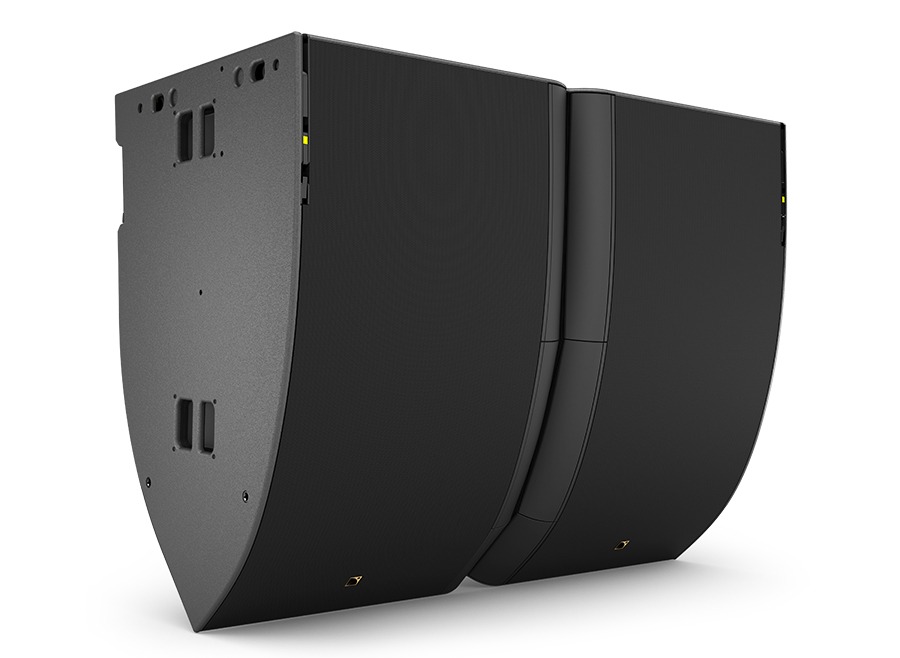
L-Acoustics unveiled L1, the flagship of the L Series, and its companion cardioid subwoofer, CS1.
Built on L-Acoustics patented Progressive Ultra-Dense Line Source (PULS) technology, L1 sets a new reference for stadium sound systems that has already been entrusted to the world’s biggest stages.
L1 has been deployed on Bruno Mars’ The Romantic tour with Clair Global, for Harry Styles’ Together Together tour with Solotech, and on Joker Xue’s world tour with MRT, as well as a debut at the Brit Awards in London with Britannia Row, a Clair Global company. CS1 delivered the low end on the main stages of Coachella Valley Music and Arts Festival with RAT Sound, and Ultra Music Festival with Unreal-Systems/AgorA.
L1 and CS1 also mark their first permanent installation at the Hollywood Bowl, deployed in a white architectural finish, and the venue where the company officially unveiled the new technology, alongside the new L-Acoustics Source Intelligence audio processing platform at Keynote 2026. The event featured a performance by The War on Drugs.
L1 breaks every performance benchmark for line array systems
Where previous large-format systems made incremental gains, L1 achieves a categorically higher concentration of transducers in an efficient form factor. Each enclosure integrates two 18″ low-cardioid (LC) transducers side-mounted for frontal energy and rear rejection, four front-facing 15-inch low-frequency drivers, eight 8-inch mid-frequency drivers, and six coaxial 4-inch +2.5-inch HF compression drivers. This HF coaxial configuration, new to the L Series, increases SPL and long-throw capabilities.
The result is a maximum SPL of 160 dB per enclosure, across a full bandwidth of 35 Hz to 20 kHz, yielding best-in-class SPL per size, per kilogram, and per sq m. The companion wide vertical coverage L1D element matches this transducer architecture with a progressive 60-degree vertical coverage pattern for nearfield zones, achieving 155 dB SPL.
“L1 represents the highest expression of power, bandwidth, and pattern control ever achieved in line array technology,” said Germain Simon, Director of Product Management, Loudspeakers at L-Acoustics. “With PULS taken to its ultimate expression, we have broken every performance benchmark we set for large-format line source. L1 is a genuine turning point for the industry.”
L1 and CS1 integrated cardioid technology transforms noise management
For large productions in urban environments, multi-stage festivals, and noise-sensitive venues, low-frequency spill is one of the most persistent engineering challenges. The L1 system addresses it at the design level.
The side-mounted 18-inch LC transducers enable L-Acoustics patented cardioid low-frequency architecture, delivering up to 18 dB of rear rejection between 20 and 250 Hz, and more than 26 dB of rejection below 80 Hz. Low-frequency energy is concentrated on the audience; spill behind the array is minimised at the source. Sound designers choose between cardioid mode for maximum rear rejection or supercardioid for extended rejection to the sides.
CS1 extends the same principle to the sub-bass range. With four 21-inch transducers in a cardioid topology, CS1 delivers peak SPL up to 150 dB and extends bandwidth down to 25 Hz. At Coachella and Ultra Music Festival, where neighbouring stage interference is a constant pressure on production engineers, CS1 delivered the sub-bass power and impact that those shows demand while preserving acoustic integrity across the site.
The new-generation Autofilter algorithm extends this control into three dimensions. Working within L-Acoustics Soundvision software, it shapes the low-frequency beam of an L1 array to rival — and in many configurations surpass — the low-frequency control of a much longer conventional professional sound system of equivalent power, down to 20 Hz, with no added latency. A single click within the standard workflow applies it. The result is greater tonal balance and stability across the venue and noticeably less low-frequency spread from front to back.
Horizontal directivity is managed by two Panflex modules per enclosure, offering 70- and 90° symmetrical patterns plus an 80-degree asymmetrical mode. L1D extends options to 110- or 70° symmetrical and 90° asymmetrical for nearfield coverage. Vertical control is built into the pre-shaped progressive geometry of L1, with 0.8° inter-element coupling for long-throw festival formats and 5 degrees for arenas and complex audience profiles.
L1 System: Three Times Faster to Deploy
For touring productions, the economics of deployment carry as much weight as acoustic performance. A configuration of two CS1, four L1, and one L1D delivers the acoustic performance of a 21-element K1 standard rig, with 66% fewer rigging actions, fewer lifts, fewer cables, and a smaller physical footprint that integrates cleanly with stage and video structures. The weight savings are equally significant. Five enclosures do the work of fifteen and weigh 20% less when rigged. A main hang of four L1 and one L1D weighs 1,263 kg, where a comparable K1 system would require 15 boxes at 1,590 kg overhead to match the same performance.
The auto-locking rigging system requires no external pins. A single SC32 cable connects the amplified controller to each enclosure. Each L1 enclosure is driven by a dedicated LA7.16 amplified controller with 16 discrete channels of DSP and amplification — one per acoustic element — enabling Autofilter and cardioid management to operate at individual element resolution across the entire hang. The LA7.16 mounts in the LA-RAK III touring rack: 48 channels of amplification in 9U, Milan-AVB-ready, delivering more than 60,000 watts per rack.
The verdict from the engineers running the shows
Across pilot deployments, the response from FOH engineers has been consistent. “This system makes a stadium sound a lot smaller than it is. Controlling the low end with a full cardioid PA pretty much eliminates the usual stuff rolling around these giant spaces. Once you add the finest mids and highs I’ve ever heard, the room just disappears,” said Sean “Sully” Sullivan, sound engineer for Bruno Mars.
“Mixing on L1 feels like driving a top-tier supercar. It’s unbelievably responsive and powerful, giving me the freedom to push the mix further than ever,” said Jun Zhang, sound engineer for Joker Xue. “Even when I pushed it to the limit, the vocals stayed silky and clear, with none of the harshness I’ve heard with other systems. And that gives me so much more confidence in my mix.”
L1 and CS1 are currently in pilot phase with a select group of L-Acoustics certified partners. Availability for qualified partners is planned for early 2027.
Viiew the full L-Acoustics Keynote 2026 presentation here: www.youtube.com/watch?v=4j881QsAm5g
www.l-acoustics.com/products/l1-system/
www.l-acoustics.com/products/cs1/
www.l-acoustics.com