
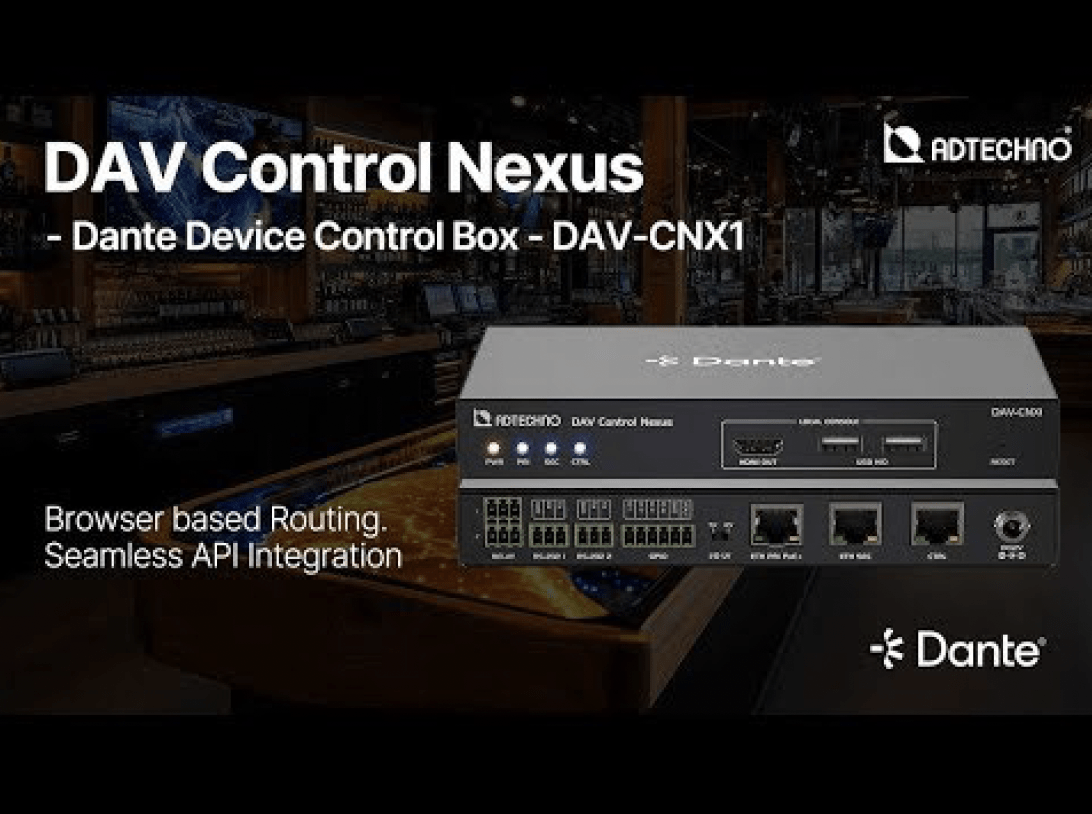
ADTECHNO has released DAV Control Nexus, DAV-CNX1, a next-generation Dante device control box that enables intuitive management and routing of Dante-enabled audio and video equipment directly from a web browser.
The DAV-CNX1 features a newly designed management interface that follows the established operational concepts of Dante Controller, enabling all Dante device operations, including routing, monitoring, network configuration, and user management, to be performed entirely within a web browser, without the need for dedicated software.
In addition to browser-based access from a PC or tablet, the device includes HDMI output and USB HID ports, allowing direct connection to a touchscreen monitor for fully standalone, PC-free operation.
The unit is equipped with dual Ethernet ports for Dante Primary and Secondary networks, supporting Dante Redundancy for reliable and continuous system operation.
A dedicated Control Ethernet port provides secure access from a network isolated from the Dante network.
Through its open API, the DAV-CNX1 supports external control via Telnet or RS-232 communication, enabling seamless integration with third-party control systems as well as control of built-in GPIO and relay terminals.
The DAV-CNX1 also includes a Preset (Scene) function for one-touch switching between preconfigured Dante routing setups.
In addition, Webhook Outbound support allows the system to send HTTP notifications to external platforms, enabling integration with collaboration tools such as Microsoft Teams and Slack, as well as automation and RPA workflows.
Key Features
• Browser-based Web GUI following the Dante Controller workflow
Enables intuitive matrix-style routing and centralized management of device information, clock status, and event logs—without requiring dedicated software
• Fully PC-free standalone operation
With built-in HDMI output and direct touchscreen support via USB HID, automatically displaying the routing screen at power-up
• One-touch switching of Dante routing configurations and system settings
Using the built-in Preset (Scene) function, with support for external API-based preset control
• Flexible integration with major third-party control systems
Supporting command transmission via Telnet or RS-232 for routing control, system status reference, and automation can be performed through the use of an open API
• Built-in GPIO and relay terminals
Allows direct physical integration with external switches and sensors, enabling autonomous execution of predefined actions such as routing changes or preset switching without an external control system
• Webhook Outbound support
Capable of sending system events and status changes to external platforms via HTTP, enabling workflow integration with systems such as Microsoft Teams, Slack, and RPA tools
• High-reliability network design with dual Dante LAN ports
Dante Primary and Secondary LAN ports support Dante Redundancy for continuous operation in mission-critical environments
• Secure role-based user management
Administrator, Operator, and View-only access levels settings, with login history and operation log recording capabilities
• Comprehensive network configuration management
Manage network configuration with independent setup of Control LAN, Dante Primary LAN, and Dante Secondary LAN, supporting both DHCP and static IP configurations via an intuitive Web GUI
“With DAV Control Nexus, DAV-CNX1, our goal was to fundamentally simplify how Dante systems are operated integrated in real-world installations,” said Shinichi Yasui, Product Manager at ADTECHNO.
“By bringing browser-based routing, PC-free standalone operation, and seamless API integration into a single device, the DAV-CNX1 allows system integrators and end users to manage Dante environments more intuitively and efficiently – without increasing system complexity.
“From small to mid-scale installations to permanent professional AV environments, the DAV-CNX1 enables flexible system design through open APIs, GPIO-triggered automation, and Webhook-based notifications.
“This approach not only streamlines daily operation, but also extends Dante workflows beyond traditional AV control, making automation and system integration easier to implement across a diverse range of applications.”