
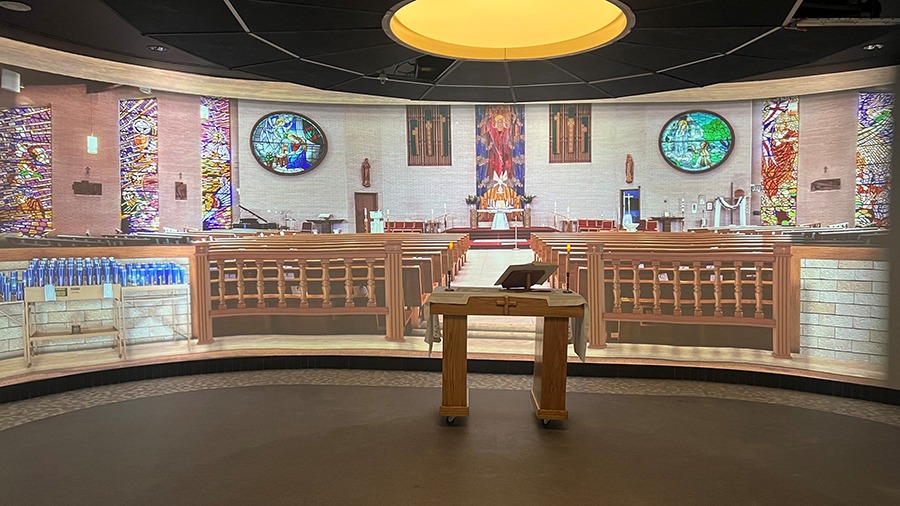
At the Wynn Hospital in Utica, New York, an immersive projection installation has transformed a traditional chapel into a multi-denominational sanctuary for reflection and prayer.
Designed by Ancora Productions and integrated with support from MayCo, the Sanctuary combines six Panasonic projectors with a Modulo Pi media server to create a seamless 360° immersive environment that gently surrounds visitors with contemplative visual scenes inspired by local religious and natural spaces.
When the new Wynn Hospital opened in downtown Utica, New York, the vision extended beyond medical care. Within the facility, the Mohawk Valley Health System (MVHS) wanted to create a dedicated space where patients, families, and staff could pause, reflect, or pray in a calm and inclusive environment.
Ancora Productions, a creative production company specialising in experiential design, content creation and AV integration, was commissioned to design and produce this experience, transforming an existing chapel into what is now known as The Bonnie Tamer Woods Sanctuary, named to celebrate the life of a past chair of the MVHS Board of Directors.
Dennis Capucilli, CEO of Ancora Productions, noted that the project, conceived as a multi-denominational immersive space combining large-scale projection with subtle environmental audio, required a mindset very different from their typical productions. “This challenge was almost the opposite of what we normally do for large shows or corporate events. Here, the objective was to create a space where people could be alone with their thoughts, while surrounding them with a comforting environment that never intrudes.”
Projection study and system definition
From the early consultation phase, Ancora brought in MayCo to support the audiovisual design and projection workflow. MayCo recommended the use of a Modulo Player Pro media server by Modulo Pi, providing the flexibility required to manage multi-projector playback, video mapping, and system control within a permanent installation.
Cody Niblett, Director of Project Management at MayCo, explained: “We selected this model because it provides six mini DisplayPort outputs. No video inputs were required for the current configuration, although the system is designed with future expansion in mind, such as integrating external sources via NDI.”
The Sanctuary itself presented a significant technical challenge. The room, approximately 840 sq ft with 11-foot ceilings, is not a perfect circle. Instead, it features four flat walls connected by rounded corners, creating a hybrid geometry that complicates projection design.
Adding to the challenge, no accurate architectural drawings or CAD files existed for the space. Ancora therefore conducted a full measurement survey, manually calculating wall radii and determining the exact centre of the room.
Based on these measurements, a detailed projection study was carried out using Modulo Kinetic Designer 2D+3D. This made it possible to determine the optimal number of projectors, lens types, and to simulate their placement to achieve seamless coverage.
“We made the investment in the study before we had a job approval because we felt that it was worthwhile, and we were happy to challenge the mathematics” said Capucilli. “To have a budget approved, we needed to know how many projectors were required. The projection study that we did using the software was very helpful to come up with a solution that we could quote, and eventually we got it approved.”
In addition, the projection study generated within Modulo Kinetic provided prepared PSD mapping files, allowing MayCo’s team to anticipate the mapping process.
The final design uses six Panasonic PT-RZ7L laser projectors, delivering nearly 360° coverage around the room.
Integrating projection into a constrained architecture
Maintaining the immersive quality of the space required the technology to remain completely hidden from view.
“To make things a little trickier, the projectors are in the ceiling, and below them is an architectural element that covers them up,” explained Capucilli. “We didn’t want to use a snorkel lens, because if we had, the projectors would have been visible to the audience. So we selected a configuration that allowed us to place the lens right at the edge of that architectural element, so visitors wouldn’t see anything.”
This constraint significantly increased the intricacy of the installation. With no clear reference points—no corners and a geometry combining flat walls and rounded sections—Ancora had to develop a precise positioning methodology.
A full-scale floor template was printed, showing the exact location of each projector lens relative to the room’s centre. After identifying the centre point, the template was aligned in the room using triangulation from the flat walls. Each lens position was then transferred vertically to the ceiling using laser measurements, allowing to determine the exact mounting points for the projector brackets.
This approach ensured that each projector lens was positioned with the required accuracy, both in location and elevation.
The projections extend from floor to ceiling—approximately 10.5 feet in height—covering the entirety of three walls and roughly 75% of the fourth wall, where the entrance doorway interrupts the projection surface.
The projection study also made it possible to anticipate masking zones, including the entrance area and specific elements such as a fire alarm. Content was therefore designed as a full 360° environment, with final masking applied within the Modulo Player media server to adapt to the physical constraints of the room.
From projection study to real-world mapping
Once the system was installed, MayCo carried out the projection mapping using a single Modulo Player Pro to feed the six Panasonic projectors. Because the Sanctuary features curved walls and a non-uniform geometry, advanced warping capabilities were essential.
“The warp system within Modulo Player was particularly important during this installation,” commented Niblett. “Each output or X-Map can support up to 155 warp control points, allowing precise control over how the projected image conforms to the projection surface.”
Real-world conditions introduced additional adjustments. “Because the room was still under active construction, the actual curved walls had slight pitch variations compared to the original design,” Niblett added. “We made final adjustments to the mapping and alignment to match the room’s real-world geometry.”
This process ensured seamless projection, with the mapping adapted to the slight variations in the room’s final construction.
Content creation for an inclusive experience
In parallel with the technical implementation, Ancora developed a series of immersive scenes designed to reflect both religious diversity and universal nature-based environments.
To create the religious content, Ancora’s team worked with imagery captured from actual churches, synagogues, and mosques located in Utica. Rather than capturing full interior panoramas, the team documented architectural details, iconic visual elements, and specific sections of each space in high resolution. These were then reconstructed and composed within Ancora’s studio to create immersive environments adapted to the Sanctuary’s geometry.
“We wanted people to potentially recognise elements from their own religious space,” Capucilli explains. “At the same time, we didn’t want a literal reproduction of those places. That gave us the freedom to design scenes that were vivid and beautiful, while still allowing people to recognise elements that are familiar to them.”
Each projection scene—which required approximately two weeks of development—creates a quiet and comforting atmosphere. Subtle animated elements such as flickering candles, drifting clouds, or flying birds add life to the visuals without distracting from personal reflection.
Simplified control through custom interface design
All scenes are played back and managed directly by the Modulo Player media server, allowing the room to dynamically transform between environments.
To simplify daily operation, the system is controlled through a custom iPad interface designed using Modulo Player. “The Modulo Player UI Designer allows fully customised control interfaces. This was important because the end client and the system operator require different levels of access,” noted Niblett. “We can create simplified interfaces for the client, while maintaining more advanced control for operators and technicians. These interfaces can also include password-protected pages for restricted system controls.”
The custom interface designed by MayCo allows staff members—referred to as “Care Angels” within the hospital—to select and launch immersive scenes with a single touch. When a scene is selected, projections fade smoothly, allowing the environment to transition without disrupting the calm atmosphere.
Completed after eight months of development, The Bonnie Tamer Woods Sanctuary now operates as a permanent immersive environment within Wynn Hospital, open 24 hours a day. It offers a peaceful space where technology quietly disappears, allowing visitors to reconnect with their thoughts and emotions.
For the teams involved, the project stands out not only for its technical challenges but also for its human impact. “It’s not a massive installation with hundreds of projectors,” Capucilli reflected. “But it leaves the world with something meaningful, and we were very happy to be part of it.”