
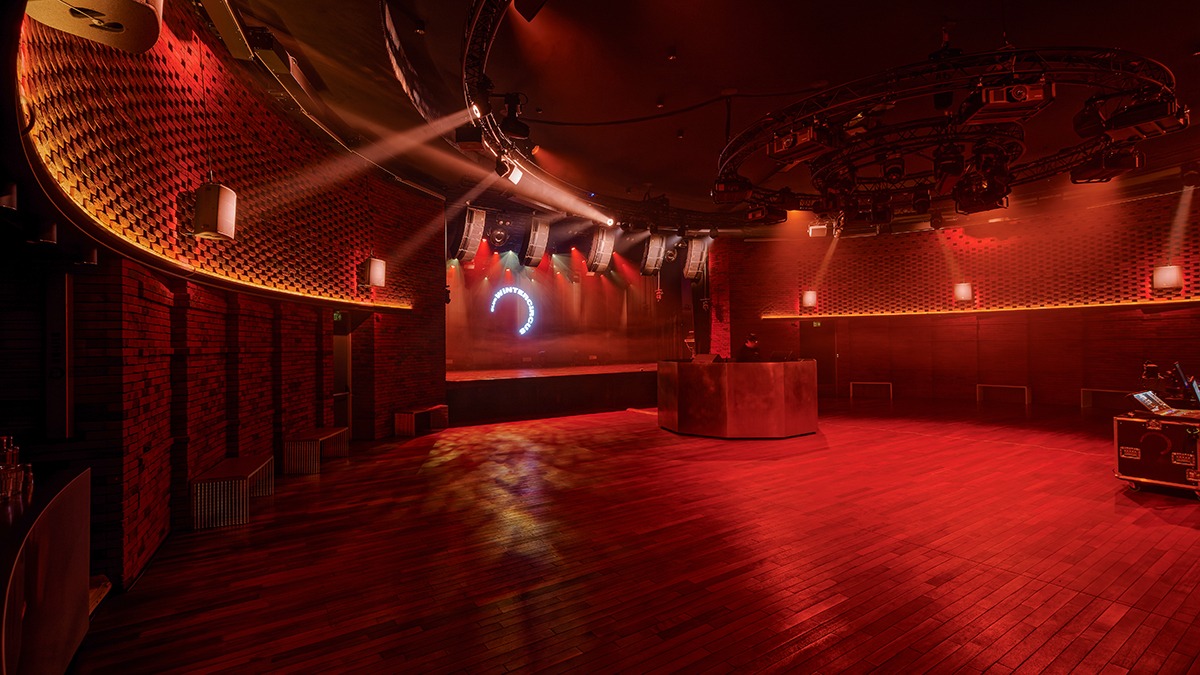
L-Acoustics Certified Partner XLR, a Belgian integration specialist, won the public tender to update the sound system for Club Wintercircus in 2024. Their answer to the brief from Ghent cultural organisations Viernulvier and Democrazy was an L-Acoustics L-ISA Immersive Hyperreal Sound installation. Their design is a full object-based installation that places every person in the 550-capacity room at the centre of the performance, regardless of where they’re standing.
“When L-Acoustics developed L-ISA, it was exactly to answer this type of demand,’ explained Louis Lukusa, CEO at XLR. “There was no doubt, this project represented the alignment of two shared visions focused on delivering an exceptional immersive experience.”
The Wintercircus building is a landmark in Ghent — a 19th-century circular structure that is part of a larger heritage redevelopment project. The club itself, however, is entirely new: purpose-built for live music and nightlife, with acoustics baked into the design from day one rather than retrofitted as an afterthought.
That circular geometry, while architecturally striking, is an acoustic challenge in its own right. Reflections and standing waves are inherent to the shape, and XLR had to model and manage them carefully. Microphone positions during calibration were chosen with the room’s geometry in mind to achieve natural, balanced coverage across the entire floor.
The structural demands went further still. With a venue designed to run at high SPL for extended periods, mechanical isolation was non-negotiable. “The entire sound system needed to be fully isolated from the building structure,” said Lukusa. “Every loudspeaker is mechanically decoupled from ceilings and walls to avoid vibration transfer and ensure complete acoustic isolation. This level of detail was essential to achieve a natural, balanced sound throughout the room.”
Soundvision, with its L-ISA extension, was central to the design process, allowing XLR to visualise spatial imaging, assess immersive coverage, and refine the system long before a single cabinet was hung.
The main front-of-house configuration features five hangs of A10i loudspeakers, each comprising three A10i Focus and one A10i Wide — a combination that delivers even tonal coverage and consistent dispersion across the audience area.
Subwoofers are positioned underneath the stage — a deliberate design choice that keeps them entirely hidden from view while maintaining powerful, clean low-frequency reinforcement. Eight KS21i units, arranged in a lightly arced configuration, provide smooth bass distribution without compromising the venue’s visual aesthetic.
Immersion beyond the front plane is delivered by eleven X12 loudspeakers for surround reinforcement and eleven X8 units deployed as elevation channels, enabling precise object-based placement of sound in three dimensions. An L-ISA Processor using 32 outputs drives the spatial engine, while the system is powered by three LA7.16i and one LA4X amplified controllers.
A P1 processor is used to bring a stereo input onto the Milan-AVB network, allowing visiting engineers to feed a simple left-right signal directly into the system when full immersive processing isn’t required. This provides a straightforward workflow for touring engineers while maintaining compatibility with the venue’s L-ISA configuration.
“The goal was to deliver the same high-quality live sound experience to every listener,” continued Lukusa. “L-ISA enables artists and engineers to think differently about spatial mixing, creating a more natural connection between performer and audience.”
The system runs entirely on a Milan-AVB network backbone, managed via two LS10 switches and integrated into an Agora MK2 Ghost switch infrastructure that carries AVB, Dante, and GigaAce traffic as a converged network over fully redundant 10-gigabit fiber. The AVB boundary clock built into the Agora switch ensures rock-solid synchronization across the entire network with imperceptible latency.
At the console, an Allen & Heath dLive handles source management and format conversion, feeding the L-ISA Processor via MADI. The result is a single unified ecosystem where all protocols coexist cleanly. “For us at XLR, Milan-AVB has become the standard whenever we work with L-Acoustics,” said Lukusa. “Keeping the entire signal path in AVB ensures maximum stability, minimal latency, and full compatibility across the installation.”
The project timeline was demanding by any measure. XLR had five weeks to design, order, install, and commission the full system, and deliver training to the venue’s technical team before opening night. They met it.
The in-house technical team at Club Wintercircus — Stan and Oliver — are, according to XLR’s project manager Vassili Golfidis, among the most capable and passionate technicians in the Belgian live sound scene. They embraced the system immediately, took full ownership from day one, and quickly became skilled L-ISA operators. “The technicians truly live and breathe the L-ISA experience — their enthusiasm and commitment match ours at XLR, and it shows in the way they operate and care for the system,” enthused Lukusa.
The ripple effect has extended to touring engineers passing through the venue. Several chose to run their shows in L-ISA after experiencing the system firsthand — and the experience changed their approach to mixing entirely. “After experiencing object-based mixing, the engineers’ entire approach to mixing changed,” confirmed Lukusa. “Since then, many have fully embraced immersive technologies in their new projects.”
“From the very first stage of assessing the quality requirements and criteria leading to a new immersive sound design for Club Wintercircus, L-Acoustics proved to be our best choice,” Concluded Oliver Houttekiet, Technical Director at Wintercircus.